Identifikasi Kebutuhan Asuhan Women Center Care Berbasis Aplikasi Pada Calon Pengantin Perempuan Yang Merencanakan Kehamilan
DOI:
https://doi.org/10.59963/nthn.v20i2.575Keywords:
women center care, preconception, pregnancy planning, health applicationAbstract
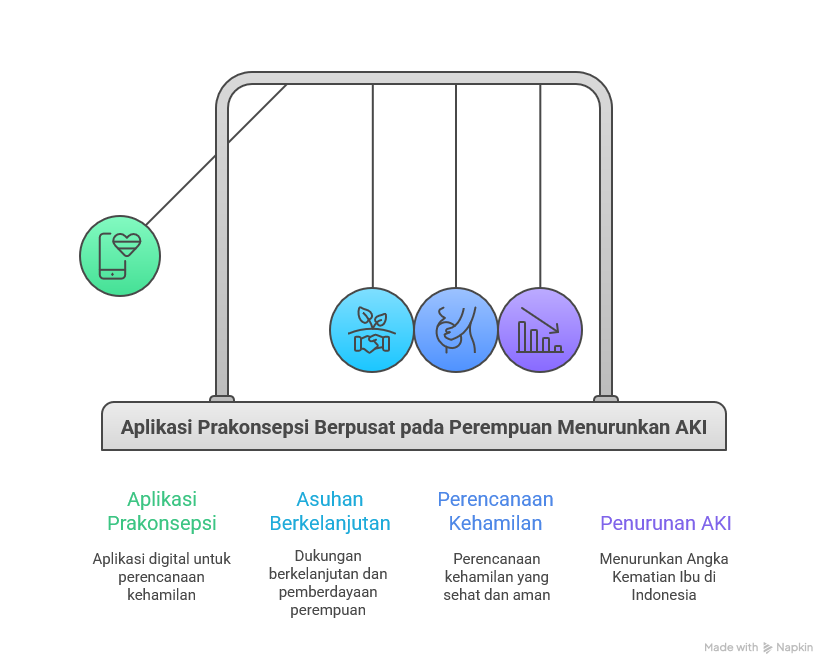
Maternal Mortality Rate (MMR) remains a significant public health concern in Indonesia, with most maternal deaths caused by pregnancy-related complications that are largely preventable through continuous midwifery care. The women center care approach places women at the center of care and represents an essential strategy for pregnancy planning beginning in the preconception period. Although digital applications have been implemented in premarital and preconception health services, their utilization has not yet fully reflected the principles of women-centered care. This study aimed to identify the need for application-based women-centered care among prospective brides planning pregnancy. A qualitative study with a phenomenological approach was conducted. Participants were selected purposively and included primary health care center heads, coordinating midwives responsible for maternal and child health services, and prospective brides who utilized premarital health services. Data were collected through in-depth interviews and analyzed using the PIECES framework (Performance, Information, Economy, Control and Security, Efficiency, and Services). The findings indicated that the currently used applications—ELSIMIL, Puscatin, and ILP—primarily focus on pregnancy eligibility screening and stunting prevention and do not comprehensively address broader preconception care needs. Limitations were identified in information provision, efficiency, continuity of care, follow-up mechanisms, and data control and security. Furthermore, no application currently supports continuous care and women’s empowerment in accordance with women-centered care principles. This study concludes that the development of an integrated, sustainable, and women-centered preconception application is critically needed to support healthy and safe pregnancy planning.
References
Al Enezi, Khaled dan Mitra Amal K.(2017). Knowledge, Attitude, and Satisfaction of University Students Regarding Premarital Screening Programs in Kuwait.
Azeem, et al.(2011). Promotion of knowledge and attitude towards premarital care: An interventional study among medical student in Fayoum University. Retrieved from : Journal of Public Health and Epidemiology Vol. 3(3), pp. 121-128, March 2011 Available online at http://www.academicjournals.org/jphe ISSN 2141-2316 ©2011 Academic Journals.
Berglund, Anna dan Linmark, Gunila.(2016). Preconception health and care (PHC)—A Strategy for Improved Maternal and Child Health. Retrievedfrom : https://www.ncbi.nlm.nih.gov/pmc/articles/PMC5098484/
Bhutta ZA, et al.(2005). Community based interventions for improving perinatal.and neonatal health outcomes in developing countries: A review of the evidence.Pediatrics 2005; 115: 519-617.
Citrakesumasari.(2012). Nutritional Anemia, problems and prevention. Yogyakarta: Kalika.
Czeizel AE.(2011). Periconceptional folic acid-containing multivitamin supplementation for the prevention of neural tube defects and cardiovascular malformations. Ann Nutr Metab. 2011;59(1):38-40.
Dainty JR, et al.(2014). Estimation of Dietary Iron Bioavailability From Food Iron Intake and Iron Status. PLoS One 2014; 9: e111824
Dean, et al. (2014). Preconception care: nutritional risks and interventions. Retrieved From : http://www.reproductive-health-journal.com/content/11/S3/S3.
Dinas Kesehatan Kota Yogyakarta.(2016). Profil Kesehatan Kota Yogyakarta Tahun 2015. Yogyakarta : Dinas Kesehatan.
Dix, Alan (2004). Human-computer Interaction.
Fuehrer, et al.(2015). Promoting preconception health in primary care. Journal of the American Academy of Physician Assistants. www. JAAPA.com
Gardiner, et al.(2008). The clinical content of preconception care: nutrition and dietary supplements. American Journal of Obstetrics & Gynecology.hony, M.Djunaidi dan Almanshur, Fauzan.(2016). Metodologi Penelitian Kualitatif. Yogyakarta : Ar-ruzz Media.
Gowan, Joseph P Mc dan Shah, Sajiv S.(2010). Prevention Of Perinatal HIV Transmision During Pregnancy. Journal Of Antimicrobial Chemotherapy.
Ibrahim, et al.(2013). Premarital Screening and Genetic Counseling program: Knowledge, attitude, and satisfaction of attendees of governmental outpatient clinics in Jeddah.Retrieved from :https://www.ncbi.nlm.nih.gov/pubmed/23290092
Handayani, O. W. K., Wiranti, I., Raharjo, B. B., & Nugroho, E. (Tahun). The Reproductive Health Behavior of High School Teenagers in Semarang, Indonesia.
Kitzmiller JL, et al.(2010). Preconception care for women with diabetes and prevention of major congenital malformations. Birth Defects Res A Clin Mol Teratol. 2010;88:791–803.
Klerman,et al.(2008). The clinical content of preconception care: care of psychosocial stressors. Am J Obstet Gynecol. 2008;199(6 suppl):S362-S366.
Lauria, et al.(2012). Smoking Behaviour before, during, and after Pregnancy: The Effect of Breastfeeding. The Scientific World Journal. Retrieved from : https://www.ncbi.nlm.nih.gov/pmc/articles/PMC3317547/pdf/TSWJ2012-154910.pdf
Lee, et al.(2014). Prevalence and risk factors for iron deficiency anemia in the Korean population: Results of the Fifth Korea National Health and Nutrition Examination Survey. J Korean Med Sci 2014; 29: 224-229.
Manakandan, Sujith Kumar dan Sutan Rosan. (2017). Expanding the Role of Pre- Marital HIV Screening: Way Forward for Zero New Infection. Open Journal of Obstetrics and Gynecology, 7, 71-79.
Munawarah dan Misdawati (2024). Quality of Health Services for Outpatients in Internal Medicine and Surgery Polyclinics at Balangan Regional Hospital. Jurnal Administrasi Negara. Al lidara Barad.
Meenakshi, et al.(2012).Obstetric behavior and pregnancy outcome in overweight and obese women: maternal and fetal complications and risks in relation to maternal overweight and obesity.J Obstet Gynaecol India.2012;62(3):276-280.
Nekui, et al.(2015). Preconception care in diabetic women. Journal of Education ~and Health Promotion
Opon, et al.(2017). Folate supplementation during the preconception period, pregnancy and puerperium. Ginekologia Polska 2017, vol. 88, no. 11.
Kementerian Kesehatan (2021). Peraturan Menteri Kesehatan Nomor 21 Tahun 2021 Tentang Penyelenggaraan Pelayanan Kesehatan Masa Sebelum Hamil, Masa Hamil, Persalinan, dan Masa Sesudah Melahirkan, Pelayanan Kontrasepsi, dan Pelayanan Kesehatan Seksual.
Yulivantina, et al (2022). Cross-Sectoral Strategy for Health Enhancement in Prospective Brides and Grooms. WOMB Midwifery Journal (WOMB Mid.J) Vol. 1, No. 1, Juni 2022
Yulivantina, et al (2021) Interprofessional Collaboration In Premarital Services At Tegalrejo Community Health Public, Yogyakarta. Journal of Health Vol 8 No 1. STIKES Guna Bangsa Yogyakarta.
Yulivantina, Eka Vicky et al.(2021). Implementation of Preconception Screening in Prospective Brides. UGM Reproductive Health Journal.
World Health Organization.(2018). Continuity and coordination of care: a practice brief to support implementation of the WHO Framework on integrated people-centred health services
WHO, (2013). Preconception care: Maximizing the gains for maternal and child health. https://doi.org/10.1016/S1002- 0721(09)60023-5
Downloads
Published
How to Cite
Issue
Section
License
Copyright (c) 2025 Nan Tongga Health And Nursing

This work is licensed under a Creative Commons Attribution-NonCommercial-ShareAlike 4.0 International License.

This work is licensed under a Creative Commons Attribution-NonCommercial-ShareAlike 4.0 International License.

Ciptaan disebarluaskan di bawah Lisensi Creative Commons Atribusi-NonKomersial-BerbagiSerupa 4.0 Internasional.