Hubungan Pendidikan Dan Usia Terhadap Pengetahuan Pasangan Usia Subur Tentang Persiapan Kehamilan Di Desa Tuksongo Borobudur
DOI:
https://doi.org/10.59963/nthn.v21i1.682Keywords:
Education, Age, Knowledge, Fertile Couples, Pregnancy PreparationAbstract
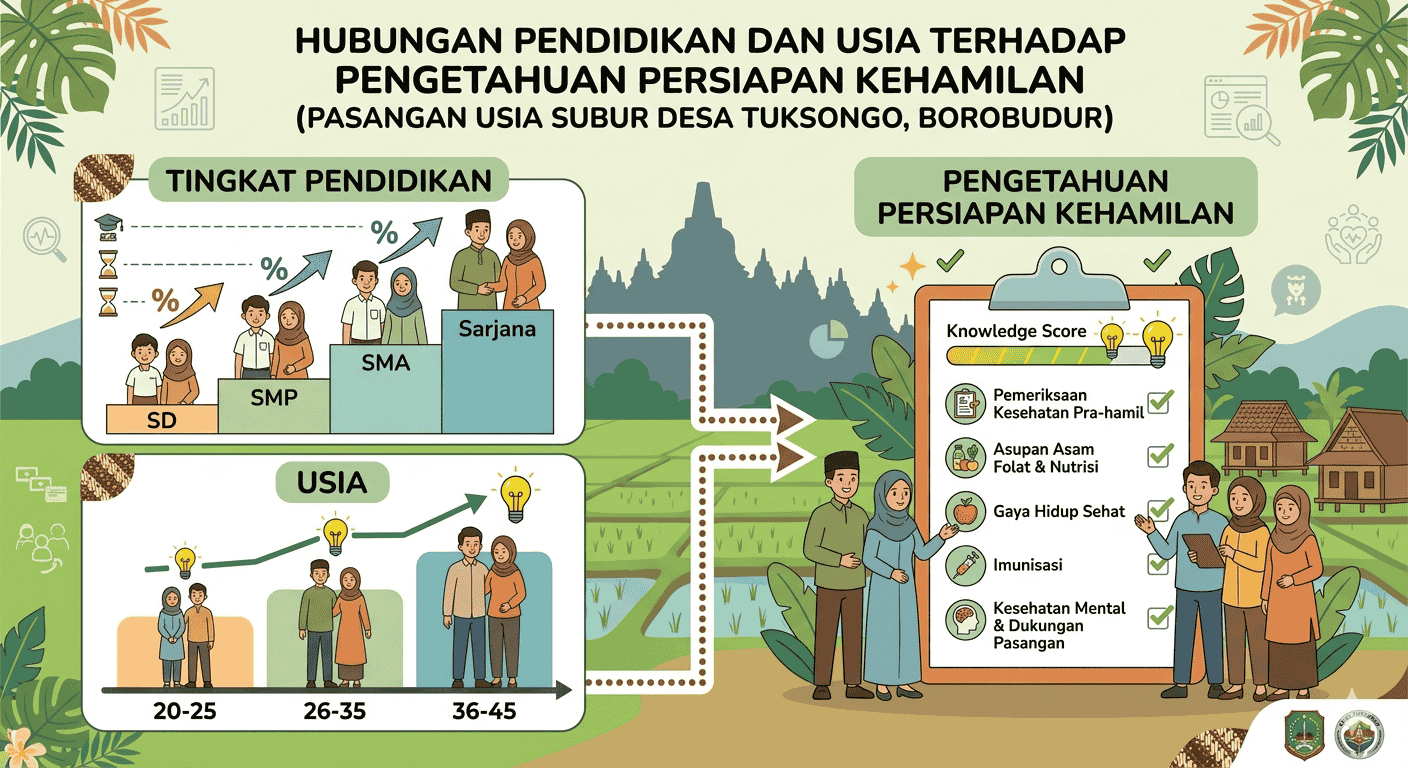
Ensuring a healthy pregnancy is an important responsibility for couples in maintaining the health of future children. Data from the 2023 Indonesian Health Survey shows that pregnancy risk factors among women aged 10–54 years in Central Java reached 27.8%, which is higher than the national average of 15.6%. Knowledge about pregnancy preparation—such as adequate nutritional intake, medical consultations, and pregnancy planning—is essential for reducing these risks. Education and age are considered important factors that may influence the level of knowledge among reproductive-age couples. This study aimed to determine the relationship between education level and age with the knowledge of reproductive-age couples (PUS) regarding pregnancy preparation in Tuksongo Village, Borobudur. This study employed a quantitative approach with a cross-sectional design. The sample consisted of 66 couples of reproductive age (132 respondents) selected using total sampling in Tuksongo Village, Borobudur. Data were collected using a true–false questionnaire containing 26 statements that had been tested for validity and reliability. Data analysis was conducted using Fisher’s Exact test. The majority of respondents had secondary education (53% of males and 56.1% of females) and were aged 20–25 years (66.7% of males and 87.9% of females). Most respondents demonstrated good knowledge regarding pregnancy preparation (84.8% of males and 89.4% of females). The analysis showed a significant relationship between education level and knowledge of pregnancy preparation among reproductive-age couples (p = 0.002; p < 0.05). However, age was not significantly associated with knowledge (p = 0.537; p > 0.05). Education is significantly associated with knowledge regarding pregnancy preparation among reproductive-age couples, while age does not show a significant relationship. Strengthening educational exposure may improve awareness and knowledge related to healthy pregnancy preparation.
References
Aini, J., Keswara, N. W., & Alfitri, R. (2025). Proceeding of The International Conference of Inovation , Science , Technology , Association between Maternal Age and Awarnes of Pregnancy Danger Sign among Pregnant Women ( At the Tapa Health Center , Bone Bolango Regency ). Proceeding of The International Conference of Inovation, Science, Technology, Education, Children, and Health 2025.
Ananta, A., Nurvidya, E., Yi, A., & Qiushi, S. (2025). Marital status transition probabilities in Indonesia : based on the 2007 and 2014 Indonesia Family Life Survey ( IFLS ). 2024, 422–445.
Ardiansyah, Rahman, A., & Fitri, N. (2025). Buku Ajar Asuhan Keperawatan Gerontik. PT Nasya Expanding Management.
Ariga, S. (2022). Hubungan Antara Tingkat Pendidikan dan Tingkat Pengetahuan dengan Perilaku Hidup Sehat , Berkualitas di Lingkungan Rumah The Relationship Between Education Level and Knowledge Level with Healthy , Quality Life Behavior in the Home Environment. Edu Society: Jurnal Pendidikan, Ilmu Sosial, Dan Pengabdian Kepada Masyarakat, 2(3), 723–730.
Asmawati, Setiawati, Y., Juliani, Mayanti, A., Yusnidar, Karimah, & Andi. (2025). Asuhan Kebidanan Pranikah dan Prakonsepsi. PT. Penerbit Qriset Indonesia.
Asrina, A., Sulymbona, N., & Anggraeni, S. D. (2023). Efektivitas Pendidikan Kesehatan Prakonsepsi Menggunakan Buku Saku Terhadap Pengetahuan Pasangan Usia Subur tentang Kehamilan Berisiko. Jurnal Ilmu Kesehatan Bhakti Husada: Health Sciences Journal, 14(02), 226–231. https://doi.org/10.34305/jikbh.v14i02.855
Bahm, A. J. (1993). Axiology: The Science of Values.
Daly, M. P., White, J., Sanders, J., & Kipping, R. R. (2022). Women’s knowledge, attitudes and views of preconception health and intervention delivery methods: a cross-sectional survey. BMC Pregnancy and Childbirth, 22(1), 1–14. https://doi.org/10.1186/s12884-022-05058-3
Harahap, L. J. (2022). Jumlah Anak (Fertilitas) Pasangan Usia Subur (PUS). PT Inovasi Pratama Internasional.
Kim, H. W., Kang, S. Y., & Kim, J. (2022). Factors influencing adolescents’ healthy pregnancy preparation behavior: a cross-sectional gender comparison applying the health belief model. Reproductive Health, 19(1), 1–10. https://doi.org/10.1186/s12978-022-01392-z
Kurniasih, D. (2022). Pengetahuan Ibu Hamil Trimester III tentang Anemia. PT. Nasya Expanding Management.
Linda, I., Santosa, H., Lubis, Z., & Siregar, M. F. G. (2023). Mempersiapkan Kehamilan yang Sehat pada Masa Prakonsepsi. Pusat Pengembangan Pendidikan dan Penelitian Indonesia.
Mayasari, E., Permanasari, I., & Hayu, R. E. (2023). Penyuluhan Gizi Pra Nikah Pada Wanita Usia Subur Dalam Upaya Menghadapi Kehamilan Sehat Untuk Mencegah Stunting. 7, 16762–16768. https://journal.universitaspahlawan.ac.id/index.php/prepotif/article/view/21938/16281
Notoatmodjo, S. (2016). Ilmu Perilaku Kesehatan. Rineka Cipta.
Oktalia & Harizasyam. (2019). Kesiapan Ibu Menghadapi Kehamilan Dan Faktor-Faktor Yang Mempengaruhinya. Ilmu Dan Teknologi Kesehatan, 3(2), 147–159.
Pakpahan, M., Siregar, D., & Susilawaty, A. (2021). Promosi Kesehatan & Perilaku Kesehatan. Yayasan Kita Menulis.
Pitriani, T., Nurvinanda, R., & Lestari, I. P. (2023). Jurnal Penelitian Perawat Profesional. Jurnal Penelitian Perawat Profesional, 5(November), 1597–1608.
Prahesti, T. (2016). Tingkat Pengetahuan Wanita Usia Subur Tentang Ovulasi Dalam Rangka Program Kehamilan Di Desa Jenggrik Kecamatan Kedawung Kabupaten Sragen. IJMS-Indonesian Journal On Medical Science, 3(2), 94–99.
Rismawati, Hanung, A., Sulistiani, A., & Dwihestie, L. K. (2024). Hubungan Pengetahuan Tentang Perencanaan Kehamilan Pada Masa Prakonsepsi Dengan Kejadian Kehamilan Risiko Di Puskesmas Karanggede. Jurnal Kesehatan Tambusai, 5, 12218–12225.
Rohayati, D., & Sutarno, M. (2024). The Effect Of Reproductive Health Education On Increasing Pre-Conception Knowledge In Young Girls At Yaspih High School Tangerang Banten In 2023. International Journal of Health and Pharmaceutical (IJHP), 4(1), 33–37. https://doi.org/10.51601/ijhp.v4i1.277
Saragih, G., & Lestari, S. W. (2019). Pengetahuan Pasangan Usia Subur Tentang Bahaya Berhubungan Seks Saat Menstruasi Di Dusun Mandiri Kabupaten Langkat Tahun 2019. 5(1), 6–12.
Swarjana, I. K. (2022). Konsep Pengetahuan, Sikap, Perilaku, Persepsi, Stres, Kecemasan, Nyeri, Dukungan Sosial, Kepatuhan, Motivasi, Kepuasan, Pandemi Covid-19, Akses Layanan Kesehatan - Lengkap Dengan Konsep Teori, Cara Mengukur Variabel, Dan Contoh Kuesioner. CV ANDI OFFSET.
Undang-Undang Nomor 4 Tahun 2019. (n.d.). tentang Kebidanan.
UU No. 20. (2003). Sistem Pendidikan Nasional.
WHO. (2016). WHO Recommendations On Antenatal Care For A Positive Pregnancy Experience.
Yeni Yusita, Sabtian Sarwoko, & Berita Afriani. (2023). Hubungan Tingkat Pengetahuan dan Usia Calon Pengantin Putri dengan Persiapan Kehamilan Pertama di KUA Kecamatan Tanjung Agung Kabupaten Muara Enim Tahun 2023. Jurnal Rumpun Ilmu Kesehatan, 4(1), 01–09. https://doi.org/10.55606/jrik.v4i1.2662
Downloads
Published
How to Cite
Issue
Section
License
Copyright (c) 2026 Nan Tongga Health And Nursing

This work is licensed under a Creative Commons Attribution-NonCommercial-ShareAlike 4.0 International License.

This work is licensed under a Creative Commons Attribution-NonCommercial-ShareAlike 4.0 International License.

Ciptaan disebarluaskan di bawah Lisensi Creative Commons Atribusi-NonKomersial-BerbagiSerupa 4.0 Internasional.